5 Hidden Features of the Go 2 You Must Know About
Introduction
The Go 2 has carved out a niche among compact electronics for people who want big capability in a pocket-sized device. On the surface it promises convenience: tiny form factor, simple controls, and quick sharing to mobile devices. Beyond those headline claims, however, the Go 2 contains several under-the-radar features that materially change how it is used in real life. This article explores five of those hidden features, explains why they matter to everyday users, and offers practical guidance for buyers weighing the Go 2 against more conventional options.
In-depth product review and analysis
Rather than rehashing marketing bullet points, this section dives into capabilities that tend to be overlooked during a typical unboxing. Each hidden feature is described, followed by real-world use cases and notes on how each can influence purchase decisions.
1. Adaptive Mounting and Magnetic Versatility
Most buyers notice that the Go 2 is small and light, but fewer appreciate how the mounting ecosystem shifts its use cases. The device’s magnetic mounting system and compact clips allow it to be attached to unconventional surfaces—helmet vents, clothing, handlebars, and even metal fixtures—without bulky accessories. This transforms it from a single-purpose gadget into a versatile capture tool.
Real-world use cases:
- Urban cyclists who want a hands-free helmet POV for commuting or recording incidents can mount the Go 2 to vents or straps with a minimal footprint.
- Content creators producing quick in-kitchen recipe shots benefit from the Go 2’s ability to clip onto a shirt or hang from a magnetic mount, enabling close, stable overhead perspectives without a tripod.
- Field technicians documenting equipment checks can temporarily attach the unit to metal cabinets or frames, freeing hands for tools and notes.
Buying note: the magnetic mounting system reduces accessory costs and simplifies setup, but buyers should verify that included mounts meet their intended mounting scenarios or budget for a small set of additional clips.
2. On-device Quick Modes and One-Tap Capture Routines
The Go 2’s interface often conceals programmable quick modes that allow users to predefine shot length, resolution profiles, and stabilization behavior, then trigger them with a single gesture. While many compact cameras focus on manual settings, this device prioritizes speed: set once, capture on-the-fly. In practice, that means reliably repeatable results in dynamic situations.
Real-world use cases:
- Action-bound users who switch rapidly between POVs—mount to helmet, then clip to chest—can preserve consistent exposure and framing by relying on a single quick mode tailored for movement.
- Social media creators producing short-form clips can program a “15-second share” mode that captures, stabilizes, and creates a clip optimized for mobile upload.
- Professionals conducting rapid site sweeps can use a predefined “document” mode that captures steady, timestamped clips for later review.
Buying note: this feature improves repeatability and reduces setup time. Buyers who value fast capture workflows—journalists, team leads, or social creators—will find the programmable quick modes a practical productivity gain.
3. Integrated App-driven Editing Templates and Auto-craft
One of the Go 2’s less obvious strengths lies in the companion app: a collection of intelligent editing templates and auto-craft features that turn raw clips into polished short videos without desktop software. Templates include pacing, auto-cuts to music, stabilization trimming, and simple color adjustments. The app’s automation reduces the friction between capture and publish.
Real-world use cases:
Find top-rated Electronics products at great prices.
Browse Now →- Small-business owners who want to showcase products quickly can shoot a few short clips and export a ready-to-post video without outsourcing editing.
- Outdoor enthusiasts who capture action on a weekend trip can edit and share highlight reels during downtime, directly from their phone.
- Teachers and trainers producing quick instructional snippets can rely on templates that emphasize clarity and keep videos succinct for learners.
Buying note: buyers who plan to do most editing on a phone should evaluate the companion app’s templates and export quality. The convenience of app-driven edits often outweighs the flexibility of desktop tools for social and field use.
4. Intelligent Battery Management and Case Ecosystem
Tiny devices face one unavoidable trade-off: battery capacity. The Go 2 tackles this with intelligent on-device power modes and a charging/holding case that extends usable time while doubling as a protective dock. Beyond simple charging, the system prioritizes power for the exact recording mode in use and can queue a recording or maintain a ready state when docked.
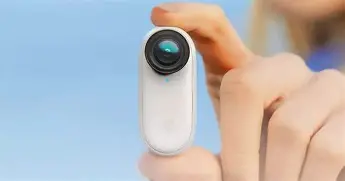
Real-world use cases:
- Event photographers can carry the Go 2 in a ready case and swap it into action without losing time recharging or fiddling with batteries.
- Field reporters working long shifts appreciate the case’s ability to keep the device in a ready-to-record state for spontaneous coverage.
- Hikers and travelers who prefer lightweight gear can use the charging case to add hours of shooting while avoiding multiple power banks.
Buying note: evaluate how the manufacturer describes case capacity and standby behavior rather than relying only on single-run battery claims. For frequent users, the combined device+case ecosystem is as important as single-session battery life.
5. Advanced Stabilization That Extends Beyond Footage Smoothing
Stabilization is often marketed as “making footage look less shaky,” but in the Go 2 it’s integrated into the entire capture chain—frame composition, crop strategies, and post-capture reframing. The stabilization system can enable creative workarounds (like smooth handheld timelapses or stable slow-motion clips) without gimbals.
Real-world use cases:
- Vloggers who record handheld while walking through busy environments achieve professional-sounding motion even in tight spaces where gimbals are impractical.
- Content creators using dynamic reframing—shoot wide handheld and crop in post for smooth zooms—gain flexibility without multiple takes.
- Automotive reviewers and dash-mounted users can rely on stabilization to produce watchable footage from car interiors with minimal vibration damping.
Buying note: stabilization effectiveness varies with movement type and lighting. Buyers should test realistic motion scenarios (running, cycling, inside vehicles) to confirm results meet expectations.
Pros & Cons
- Pros:
- Extremely portable and easy to mount in many places
- Quick, one-tap modes streamline capture
- Smart companion app accelerates editing and sharing
- Charging case extends usable runtime and protects the device
- Advanced stabilization reduces the need for bulky accessories
- Cons:
- Limited manual controls compared with larger camera rigs
- Small sensors can struggle in low-light situations
- Mounting magnetism requires care with delicate fabrics or electronics
- Accessory ecosystem may require additional purchases for niche use cases
How the Go 2 Compares
For many buyers, the real decision is whether to choose a compact device like the Go 2, a full-sized action camera, or rely on a flagship smartphone. The table below highlights practical differences buyers typically care about.
| Feature | Go 2 | Typical Action Camera | Flagship Smartphone |
|---|---|---|---|
| Portability | Excellent — pocketable, lightweight | Good — compact but larger than Go 2 | Good — always carried, but bulkier for mounts |
| Mounting Versatility | High — magnetic clips and creative mounts | High — wide accessory ecosystem | Moderate — requires clamps or dedicated mounts |
| Stabilization | Advanced — software-driven, reframing-capable | Excellent — optical and electronic options | Excellent — hybrid optical/electronic |
| Image Quality (low light) | Moderate — small sensor trade-offs | Good — larger sensors on higher-end models | Very good — larger sensors and computational processing |
| Editing Workflow | Streamlined — app templates and auto-craft | Variable — some models offer app features | Strong — native editing apps and third-party tools |
| Battery & Runtime | Good with case — case extends practical use | Good — swappable batteries on many models | Variable — phone battery used for many tasks |
| Price vs. Value | High value for portability and convenience | High value for quality and accessory flexibility | High upfront cost but multi-use device |
Buying Guide: What to Consider Before Choosing the Go 2
To determine whether the Go 2 is the right choice, buyers should weigh the following factors against their typical use cases and priorities.
1. Intended Use and Mounting Needs
Buyers who value hands-free capture (commuting, POV sports, quick social posts) will benefit most from the Go 2’s mounting versatility and small form factor. If the plan includes professional-level production—multi-camera shoots, extensive low-light work, or advanced manual control—then a larger action camera or interchangeable-lens system may be more appropriate.
Find top-rated Electronics products at great prices.
See Deals →2. Editing Workflow: Phone vs. Desktop
If most edits will be done on a phone and the priority is fast turnaround to social channels, the Go 2’s companion app and templates offer a time-saving advantage. Conversely, if the buyer intends to perform nuanced color grading or multi-clip timelines on desktop software, ensure the Go 2��s export formats and bitrates meet workflow requirements.
3. Battery Strategy and Accessories
Single-session runtime can be limiting on any small device. Buyers should consider the charging case and plan for accessory purchases like spare mounts or a small power bank if long continuous recording is expected. The charging case model turns the Go 2 into a practical all-day tool for many users.
4. Stabilization Expectations
Stabilization does a lot of heavy lifting, but it cannot replace good capture technique or compensatory accessories in extreme conditions. Prospective buyers should test the device in scenarios that mirror their typical movement—running, cycling, vehicle-mounted—to confirm the stabilization meets expectations.
5. Durability and Weather Resistance
Check manufacturer claims about splash resistance or waterproofing and whether additional housings are required for underwater use. For outdoor users who often face rain, mud, or salt spray, a protective case or waterproof housing might be essential.
6. Price and Total Cost of Ownership
Beyond the device itself, factor in necessary mounts, a charging case (if not included), spare parts, and potential accessories. Some buyers prefer to invest a little more upfront for a robust accessory set that extends the device’s versatility.
Quick checklist before purchase
- Does the included mounting set match typical use cases, or will additional clips be needed?
- Is the companion app available on the buyer’s smartphone platform and does it offer the desired export options?
- Does the charging case or battery accessory meet the expected runtime for daily use?
- Are stabilization results acceptable in test scenarios like walking, cycling, or car mounting?
- Is the warranty and customer support adequate for the intended use environment?
Practical Tips and Tricks
To get the most out of the Go 2 in real-world use, consider these practical tips:
- Pre-program quick modes for your three most common shooting scenarios (e.g., commute, social clip, documentation) so capturing is immediate and predictable.
- Use the magnetic mounts on soft fabric with an intermediary clip or seam to avoid damage or misalignment.
- Carry the charging case in a pocket rather than the main bag to maximize easy access during day-long shoots.
- When stability is vital—such as cycling at speed—combine the device’s stabilization with a secure mount rather than relying on software alone.
- Periodically update firmware and app software: stabilization algorithms and editing templates often improve through updates.
Conclusion
The Go 2 is an appealing choice for buyers who prioritize portability, rapid capture workflows, and creative mounting flexibility. Its hidden strengths—magnetic mounting versatility, one-tap capture routines, powerful app-driven templates, a supportive charging case ecosystem, and advanced stabilization—make it more than just a “tiny camera.” These features reshuffle the practical trade-offs that buyers normally face when choosing between compact devices, action cameras, and smartphones.
For everyday users, commuters, social creators, and professionals needing a lightweight second camera, the Go 2 offers uniquely useful capabilities that shorten the gap between capture and publish. As with any compact device, it’s important to test it in the most common real-world scenarios the buyer expects to encounter—lighting, motion, and mounting. Evaluated on those grounds, the Go 2 can be a surprisingly powerful tool that rewards buyers who value speed, convenience, and creative flexibility.